Quartz and quartzite sound almost identical, and in the showroom they can look surprisingly similar. Both come in bright whites, soft grays and dramatic marble-look veining. But they are very different materials, and choosing the wrong one for the way you cook can lead to disappointment years later.
This guide compares quartzite vs. quartz countertops for Chicago-area kitchens: what each one is made of, how they handle heat, stains and scratches, how much maintenance they need, how they look and what drives the price. By the end, you will know which material fits your kitchen, your style and your daily routine.
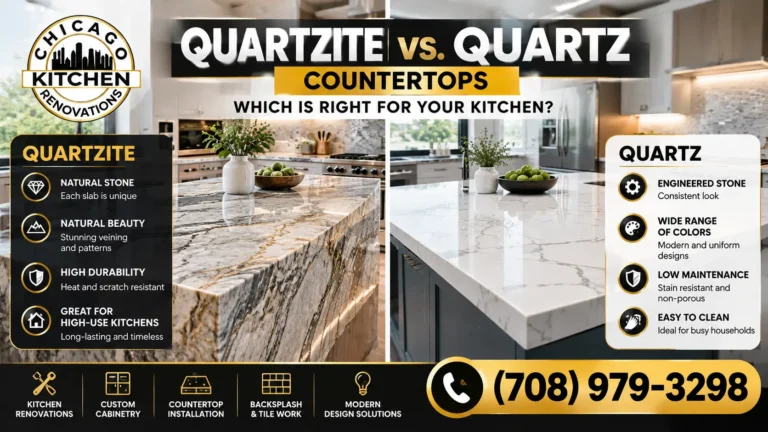
Quartzite is a natural stone, quarried and cut into slabs. It is very hard, handles heat better than quartz, and every slab is unique, but it needs periodic sealing. Quartz is an engineered surface made mostly of ground quartz bound with resin. It is non-porous, needs no sealing and offers consistent patterns, but high heat can damage it. Choose quartzite for natural beauty and heat tolerance; choose quartz for low maintenance and consistency.
Choosing countertops for your remodel? Call (708) 979-3298 or contact us for a free in-home consultation.
What Is Quartzite?
Quartzite is a natural metamorphic rock. It forms when sandstone is exposed to intense heat and pressure deep in the earth, fusing the quartz grains into an extremely hard, dense stone. Slabs are quarried, cut and polished, so no two are exactly alike.
Quartzite is known for:
- Natural movement and veining that often resembles marble
- High hardness and scratch resistance
- Good tolerance for heat
- One-of-a-kind slabs
What Is Quartz?
Quartz countertops are engineered. Manufacturers combine ground natural quartz with resins and pigments, then press and cure the mixture into slabs. Because they are manufactured, colors and patterns are consistent from slab to slab.
Quartz is known for:
- A non-porous surface that resists stains
- No sealing required
- Consistent colors, from solid whites to marble-look patterns
- Wide availability in many styles
Side-by-Side Comparison
| Feature | Quartzite | Quartz |
|---|---|---|
| Material | Natural stone | Engineered stone with resin |
| Appearance | Unique natural veining, every slab different | Consistent patterns, wide color range |
| Hardness and scratch resistance | Very high | High |
| Heat resistance | Good, though trivets are still recommended | Lower; high heat can scorch or discolor resin |
| Stain resistance | Good when sealed | Excellent, non-porous |
| Sealing | Periodic sealing recommended | Not required |
| UV and outdoor use | Generally better suited to sunny spaces | Prolonged direct sunlight may cause fading |
| Fabrication | Harder to cut, more skilled work | Easier and more predictable |
| Typical cost | Often higher | Wide range, often lower |
Heat: The Biggest Practical Difference
If you often move pans straight from the stove or oven to the counter, heat matters.
- Quartzite handles heat well because it is natural stone. Using trivets is still wise to protect the sealer and avoid thermal shock.
- Quartz contains resin, which can scorch, yellow or crack under high heat. Hot pans, slow cookers and air fryers should sit on trivets or boards.
Home cooks who bake often or use the counter as a landing zone for hot cookware often lean toward quartzite.
Stains and Maintenance
Quartz is the lower-maintenance choice. Its non-porous surface resists wine, coffee, oil and tomato sauce without sealing. Wipe with mild soap and water and it stays looking new.
Quartzite is porous to varying degrees, so it should be sealed. How often depends on the specific stone and how the kitchen is used. A sealed quartzite countertop resists stains well, but spills such as oil or wine should be wiped up promptly.
Know your stone: Some stones sold as quartzite are actually softer stones that can scratch or etch more easily. Ask to see the slab in person, ask your fabricator about the specific stone, and test a sample with lemon juice and a knife edge before committing.
Appearance: Natural Character vs. Consistency
Choose quartzite if
- You want the natural movement and depth of real stone
- You love the look of marble but want a harder surface
- You enjoy the idea of a one-of-a-kind slab
- You plan a statement island or full-height backsplash
Choose quartz if
- You want a predictable look that matches the sample
- You prefer solid colors or subtle patterns
- You want seams and patterns to match across a large kitchen
- You want a modern, uniform appearance
For a statement island, both can work beautifully. See our guide to kitchen island customization for layout ideas.
Choosing Slabs: What to Expect
With quartzite, you should select your actual slabs. Because every slab is different, the piece you see is the piece you get. Plan for a visit to the stone yard and ask about vein direction on islands and backsplashes.
With quartz, a sample is usually a good representation of the finished surface, which makes choosing easier and faster. Visit our showroom to compare options, or read our Chicago kitchen showroom guide before your visit.
Fabrication and Installation
Quartzite is harder to cut and polish, so fabrication takes more skill and time. Edge profiles, sink cutouts and mitered edges all require care. Quartz is easier to fabricate, which can shorten lead times and reduce labor.
Both materials need accurate templating after cabinets are installed and level. Our kitchen countertop installation covers templating, fabrication coordination and installation.
What Drives the Cost?
Both materials span a wide price range. The main cost drivers are:
- The specific stone or quartz collection
- The number of slabs required
- Edge profiles and mitered edges
- Cutouts for sinks, cooktops and outlets
- Full-height backsplashes or waterfall sides
- Fabrication complexity
Quartzite is often priced higher than many quartz options because it is quarried natural stone and harder to fabricate. Premium quartz collections, however, can overlap with quartzite pricing. For broader budgeting, see how much a kitchen remodel costs in Chicago.
Which Is Better for Your Kitchen?
| Your Priority | Better Choice |
|---|---|
| Lowest maintenance | Quartz |
| Heat tolerance for heavy cooking | Quartzite |
| Natural, unique veining | Quartzite |
| Consistent pattern and color | Quartz |
| Busy family kitchen with kids | Quartz, or a well-sealed quartzite |
| Sunny kitchen with lots of direct light | Quartzite |
| Tighter budget | Quartz |
Pairing Countertops With Cabinets and Backsplash
Countertops work best when they are chosen alongside cabinets and lighting. Warm wood cabinets pair beautifully with creamy quartzite, while crisp painted cabinets suit bright white quartz. See our kitchen cabinets, explore lighting and fixtures, and read our kitchen cabinets and countertops guide.
For a wider comparison that includes granite, laminate and other surfaces, read the best choice for kitchen countertops.
Countertops Across Chicagoland
We install quartz and quartzite countertops in kitchens across Orland Park, Tinley Park, Palos Park, Frankfort and Chicago neighborhoods such as River North. See completed kitchens in our gallery.
Still deciding between quartzite and quartz?
We will help you compare samples, slabs and costs for your kitchen.
Call (708) 979-3298 Request a Free ConsultationPlanning a full remodel? See our kitchen remodeling services.
Quartzite vs. Quartz FAQs
What is the main difference between quartzite and quartz?
Quartzite is a natural stone cut from quarries. Quartz is an engineered surface made from ground quartz and resin.
Which is more durable?
Both are very durable. Quartzite is extremely hard and handles heat well. Quartz is non-porous and highly stain resistant but can be damaged by high heat.
Can I put hot pans on quartzite?
Quartzite tolerates heat better than quartz, but trivets are still recommended to protect the sealer and avoid sudden temperature changes.
Can I put hot pans on quartz?
No. The resin in quartz can scorch, discolor or crack under high heat. Always use trivets or hot pads.
Does quartzite need to be sealed?
Yes. Quartzite should be sealed periodically. How often depends on the specific stone and how heavily the kitchen is used.
Does quartz need to be sealed?
No. Quartz is non-porous and does not require sealing.
Which looks more like marble?
Both can. Quartzite offers natural, marble-like movement, while quartz offers marble-look patterns with consistent color from slab to slab.
Is quartzite more expensive than quartz?
Often, because it is quarried natural stone and harder to fabricate. Premium quartz collections can be priced similarly to some quartzite.
How do I know if a stone is real quartzite?
Ask your fabricator about the specific stone and test a sample for scratching and etching. Some softer stones are sometimes marketed as quartzite.
Which is better for a family with young kids?
Quartz is often the easiest choice because it needs no sealing and resists stains. A well-sealed quartzite also performs well with prompt cleanup.
Should I choose my exact slab?
For quartzite, yes, because every slab is different. For quartz, a sample usually represents the finished surface well.
Can either be used for a waterfall island?
Yes. Both are popular for waterfall islands. Quartzite offers natural vein matching, while quartz offers consistent patterns.
Choose the Surface That Fits Your Life
When comparing quartzite vs. quartz countertops, there is no single winner. Quartzite offers natural beauty and heat tolerance. Quartz offers easy care and consistency. The right choice depends on how you cook, how much maintenance you want and the look you love.
Chicago Kitchen Renovations helps homeowners across Chicago and the southwest suburbs choose and install the right countertops. Call (708) 979-3298 to start planning.
