
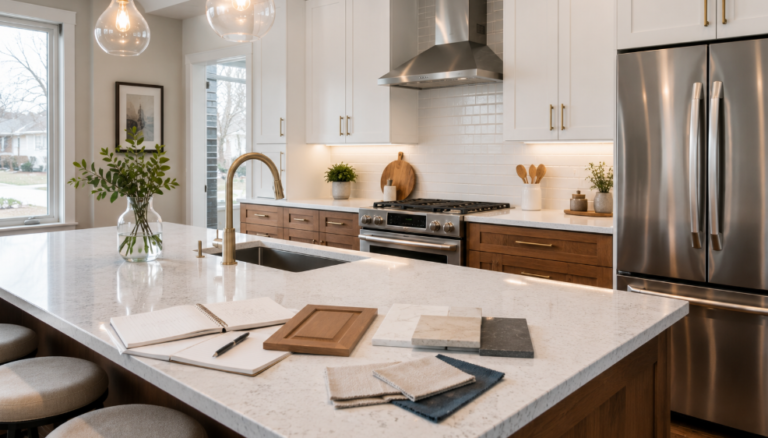
A kitchen remodel in Chicago costs $25,000 to $150,000 or more in 2026, depending on the size of your kitchen, how much you change the layout, and your finish level. Budget refreshes average $25,000–$40,000, mid-range renovations run $45,000–$85,000, and high-end transformations reach $90,000–$150,000+. Per square foot, expect roughly $175–$450.
Those ranges reflect what Chicago-area homeowners are actually paying right now — not national calculator averages, which tend to run low for our market. Below is a tier-by-tier guide, a line-item budget breakdown, and the specific factors that push a Chicago kitchen up or down the scale. If you’re weighing a full kitchen renovation against a lighter update, this will help you set a realistic number before you talk to any contractor.
Kitchen remodel cost by tier
The single biggest driver of cost is scope — how much you’re changing. Most Chicago projects fall into one of three tiers.
| Tier | Typical cost (2026) | What’s included |
|---|---|---|
| Budget refresh Cosmetic | $25,000–$40,000 | Same layout; cabinet refacing or painting, entry-level quartz or laminate counters, new flooring, updated fixtures and standard appliances. Plumbing/electrical stay put, so permit-heavy work is avoided. |
| Mid-range Most common Popular | $45,000–$85,000 | New semi-custom cabinets, quartz or natural-stone counters, tile backsplash, quality stainless appliances, layered lighting, and minor layout tweaks. Permits usually required. |
| High-end Full gut | $90,000–$150,000+ | Fully custom cabinetry, premium stone (quartzite, marble), pro-grade appliances (Wolf, Sub-Zero), custom lighting, and structural or layout changes. |
Where the money goes: budget breakdown
Cabinets are the single largest line item in almost every kitchen remodel — typically 30–40% of the total budget. Labor and installation come next, followed by countertops and appliances. Here’s how a typical mid-range Chicago project (about $65,000) divides up.
| Line item | Share of budget | On a $65,000 remodel |
|---|---|---|
| Cabinetry & hardware | ~35% | $22,750 |
| Labor & installation | ~28% | $18,200 |
| Countertops | ~12% | $7,800 |
| Appliances | ~12% | $7,800 |
| Flooring, backsplash & lighting | ~8% | $5,200 |
| Plumbing & electrical | ~5% | $3,250 |
Component costs at a glance
If you’d rather build a budget from the ground up, these are the current Chicago-area ranges for each major component:
- Cabinets: stock $150–$300 per linear foot installed; semi-custom $300–$600; full custom $500–$1,200. Full-kitchen total commonly $8,000–$60,000+.
- Countertops: $50–$150 per square foot installed, over an average of ~35 square feet.
- Appliances: a quality mid-range package runs $5,000–$12,000.
- Flooring: $5–$20 per square foot installed (hardwood or luxury vinyl plank are common choices).
- Plumbing & electrical: budget $3,000–$8,000 on a mid-range project; moving a sink adds $2,000–$4,000, and updating older bungalow wiring to grounded circuits can add $3,000–$10,000.
- Backsplash & lighting: together roughly $2,000–$5,000.
- Permits: $1,200–$4,200 depending on scope. Chicago raised its minimum building-permit fee to $602 in 2026, with electrical and plumbing billed as separate trade permits.
Why Chicago costs more than the national average
Chicago kitchen remodels typically run 15–25% above national averages. A handful of local realities explain the premium:
- Higher skilled-labor rates. Chicago-area contractors, plumbers, and electricians command rates well above national medians.
- Strict city building codes and a permit process that’s slower than surrounding suburbs.
- Older housing stock. Bungalows, two-flats, and vintage walk-ups often hide outdated wiring or plumbing that has to be brought up to code once walls open up.
- Condo and high-rise restrictions. Limited work hours, elevator scheduling, and building rules can add 15–22% to labor on downtown projects, plus extra time for HOA approval.
Suburban projects tend to run only slightly cheaper — usually 5–10% — mostly from faster permitting and marginally lower overhead.
Is a kitchen remodel worth it?
Kitchen remodels are among the higher-return home improvement projects. National estimates commonly put the cost recouped at resale somewhere around 60–80%, though the exact figure varies widely by report, neighborhood, and how much you spend. If you’re staying in your home for several years, the day-to-day gain from a kitchen that works the way you want usually outweighs the resale math. Treat the resale number as a floor, not the whole reason to do it.
Frequently asked questions
How much does a kitchen remodel cost in Chicago?
A kitchen remodel in Chicago costs $25,000 to $150,000 or more in 2026, depending on scope and finish level. Budget refreshes average $25,000–$40,000, mid-range renovations run $45,000–$85,000, and high-end transformations reach $90,000–$150,000+. Per square foot, expect roughly $175 to $450.
What is the most expensive part of a kitchen remodel?
Cabinetry is almost always the single largest line item, typically 30–40% of the total budget. Labor and installation are next at about 25–35%, followed by countertops and appliances.
How much do kitchen cabinets cost in the Chicago area?
Stock cabinets run about $150–$300 per linear foot installed, semi-custom $300–$600, and full custom $500–$1,200. Across a full kitchen that usually totals $8,000 to $60,000 or more depending on the grade.
Why do kitchen remodels cost more in Chicago than the national average?
Chicago remodels typically run 15–25% above national averages, driven by higher skilled-labor rates, strict city building codes, older housing stock that hides outdated wiring and plumbing, condo and high-rise restrictions, and permit fees that rose in 2026.
Do kitchen remodels add value to a Chicago home?
Yes — they’re among the higher-return projects. National estimates commonly place cost recouped at resale around 60–80%, though it varies by report, neighborhood, and finish level. For homeowners staying several years, daily livability often matters more than the resale figure.
